
Markets and/as information systems
What Chile's cybernetic experiment can teach us about cities today



Markets as information systems
The meteoric rise of betting platforms like Kalshi and Polymarket has prompted an important public conversation about the role – and the legality – of markets as information systems. These high-profile companies use crowd intelligence, via bets, to predict the outcomes of any (truly any) decisive future state.
But crowdsourced prediction is not the only way that markets can convey information. A classical definition frames a market as a tool for aligning supply with demand, using price as the basic “unit” of information (a unit that accounts for material and labor costs, scarcity, and time). “The so called ‘market mechanisms’ of capitalist economic theory can be regarded in ideal form as self-regulatory cybernetic feedback systems implementing the collective aspects of the preferences of individual decision makers,” according to Campbell (1999 p.19).
Markets are effective, but they aren’t the only self-regulatory cybernetic feedback system for that kind of information. In the mid-twentieth century, a diverse field of political economists, technologists, management theorists, and revolutionaries were all asking variations of the question: is it possible to design – and actually construct – a non-capitalist solution to the complex information problem of supply and demand?
This week’s post is animated by a charismatic protagonist, unfolds in post-revolutionary Chile, and rises to a climactic scene set in a room that can only be described as “Bond villain vibes”. The story is fun, of course, but it is also instructive. Cybersyn, as it was called, has lessons for large-scale information management problems, even (and especially) within a market dynamic like real estate or urban data analysis. This is a historical perspective on the Cognitive Imperative of Adaptive Urbanism.
A cybernetic experiment
“[We are] now in a position from which it is possible to implement on a national scale – at which cybernetic thinking becomes a necessity – scientific views on management and organization,” stated a 1971 letter from Fernando Flores, technical director of Chile’s new economic development agency CORFO. The letter was addressed to Stafford Beer, a larger-than-life management consultant from the United Kingdom, and it included an invitation to Chile. It probably would not have taken a national-scale implementation opportunity to get Beer, onto a first class flight to Santiago, but an opportunity of this magnitude was impossible for him to ignore.
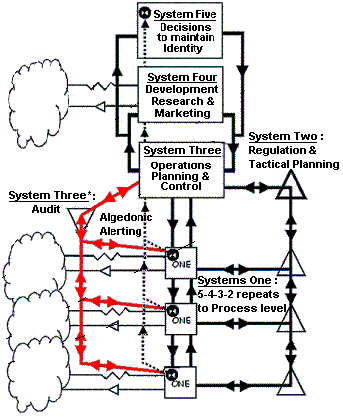
Stafford Beer was a unique kind of management consultant. After studying philosophy, he served in the UK military, where he gathered observations of efficient command under conditions of uncertainty. In the career that followed, Beer merged scientific operations research with practices for organizational learning, and embraced the concept of cybernetics from computation. “Cybernetics” refers to feedback loops and control mechanisms that enable a system to act, learn, and adapt in complex, changing environments.
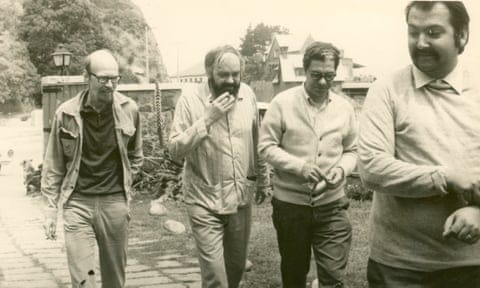
By the time he received the letter from Chile, Beer had become known for his work consulting with companies, books, and lectures. But Flores was describing a once-in-a-lifetime opportunity: to save a turbulent socialist economy with technology.
On November 4, 1971, Stafford Beer left behind a stagnant UK – gray weather, conservative politics – for the heat of a Chilean summer, still sparking with revolutionary energy. With the imprimatur of Chile’s government, Beer was tasked with designing and implementing a technical system for managing Chile’s industrial ecosystem without a capitalist market.
The task was not theoretical. When Salvador Allende was elected Socialist president of Chile in 1970, his agenda centered on nationalizing hundreds of companies and incorporating worker participation in their operational management. As foreign managers fled and workers seized factories, there was a sudden lack of managerial expertise. Allende’s government faced the challenge of maintaining industrial output, without price signals or competitive feedback.
Chile was not the only Socialist country grappling with the challenge. At the time, “Cybernetic Socialism” was an area of study, but real solutions had never been attempted at scale with the cutting edge technologies available. For Beer, it was an unprecedented opportunity to advance the theory and practice of cybernetics.
Project Cybersyn
In under a year, Beer and his collaborators designed a technical nervous system for the Chilean economy and named it Project Cybersyn. It had four components. Cybernet linked factories to a central communications hub via a repurposed network of telex machines. Cyberstride was statistical software for processing factory data and modeling policy impacts. Cyberfolk was a system for continuously aggregating citizen sentiment, using a simple happiness dial in every home (it looked like a thermostat, and enabled citizens to share their satisfaction with the government in real time). The Opsroom was a futuristic hexagonal chamber with swivel chairs, toggles, and wall-mounted displays, offering total immersion in economic data.
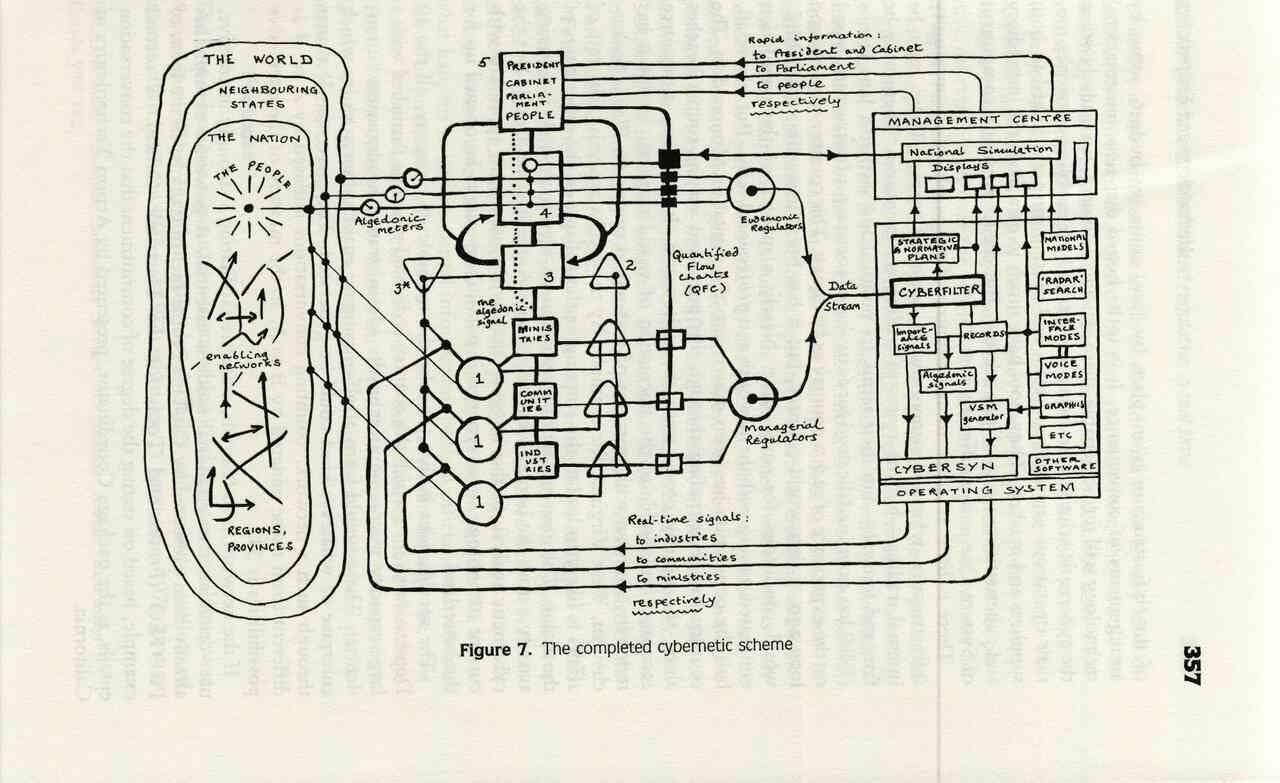
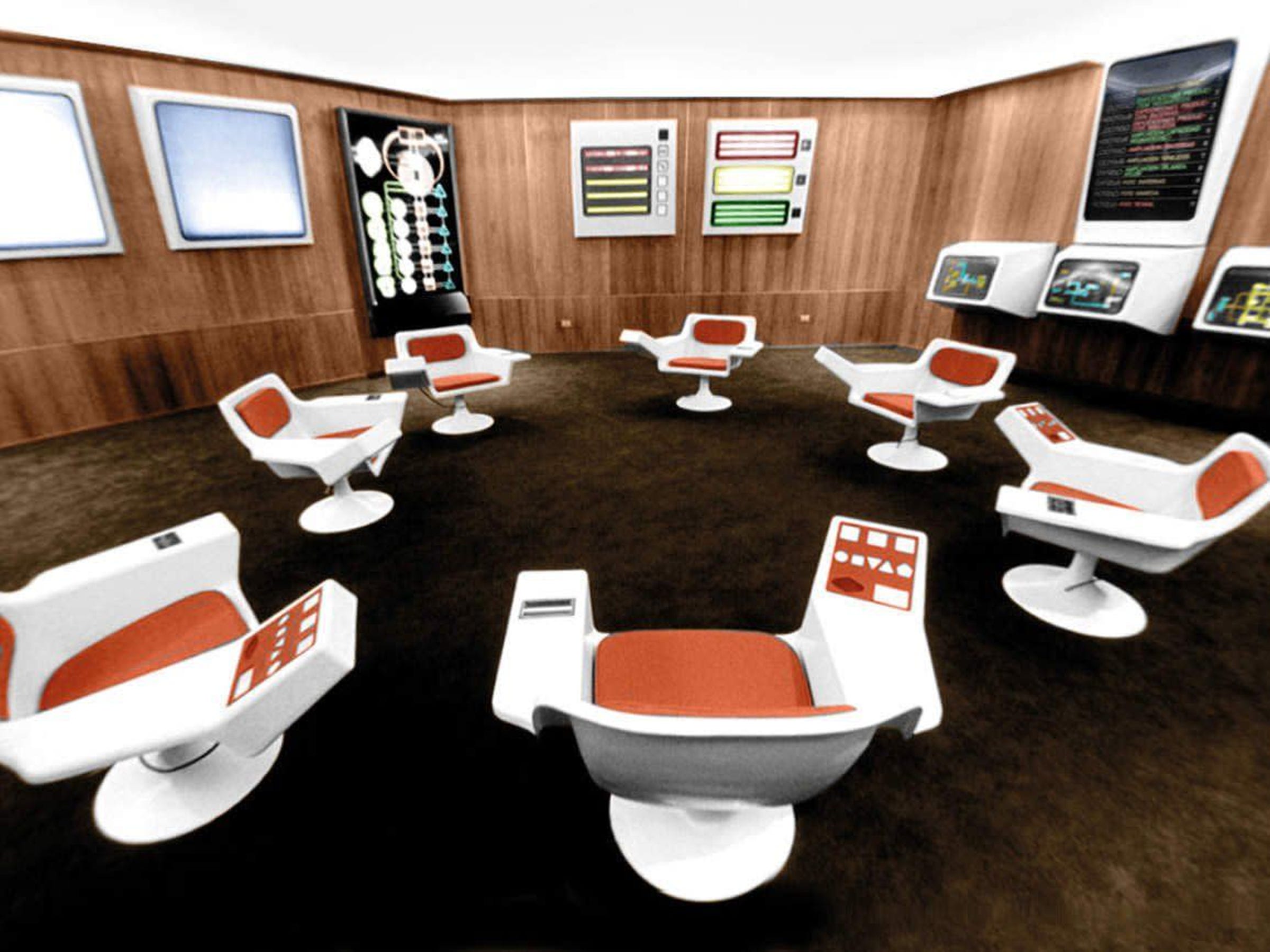
Practical success never measured up to Stafford Beer’s conceptual ambition. The Cybersyn suite was something between a prototype and film prop – Cyberfolk was never implemented, and the Opsroom was an intricate configuration of false walls and manual data entry.
Cybernet offered some practical value during a CIA-backed factory strike, where the telex network allowed the administration to monitor scarcity in real time and deploy support from loyalists strategically. They moved faster than the operatives trying to destabilize the industrial ecosystem, and the strike was quelled. Cybernet was helpful as an information network, but it was far from performing as a cybernetic economic nervous system for connected parts to share information and adapt.
Pinochet’s US-backed coup came on September 11, 1973. With the presidential palace in flames, Allende dead, and tanks surrounding CORFO, team members fled. When soldiers finally reached the Opsroom, they stabbed each screen with a knife.
A political theory of information flows
Beer’s experience in Chile transformed him from a management consultant to somewhat of a political theorist, convinced that cybernetics was more interesting as a theory of continuous institutional adaptation than as an efficient management technology.
He went on to develop ideas about sociotechnical systems operating at the intersection of bureaucracy and technology, asking questions like: How does technology deliver relevant information about supply and demand? Who makes decisions? Is the system structured for stasis or for continuous testing, learning, and adaptation?
These questions are no less relevant today, half a century later, and in a very different political economy. Cybersyn aimed to replace the market with a technical information system. What if a technical information system could enable a market to learn and adapt toward positive civic outcomes?
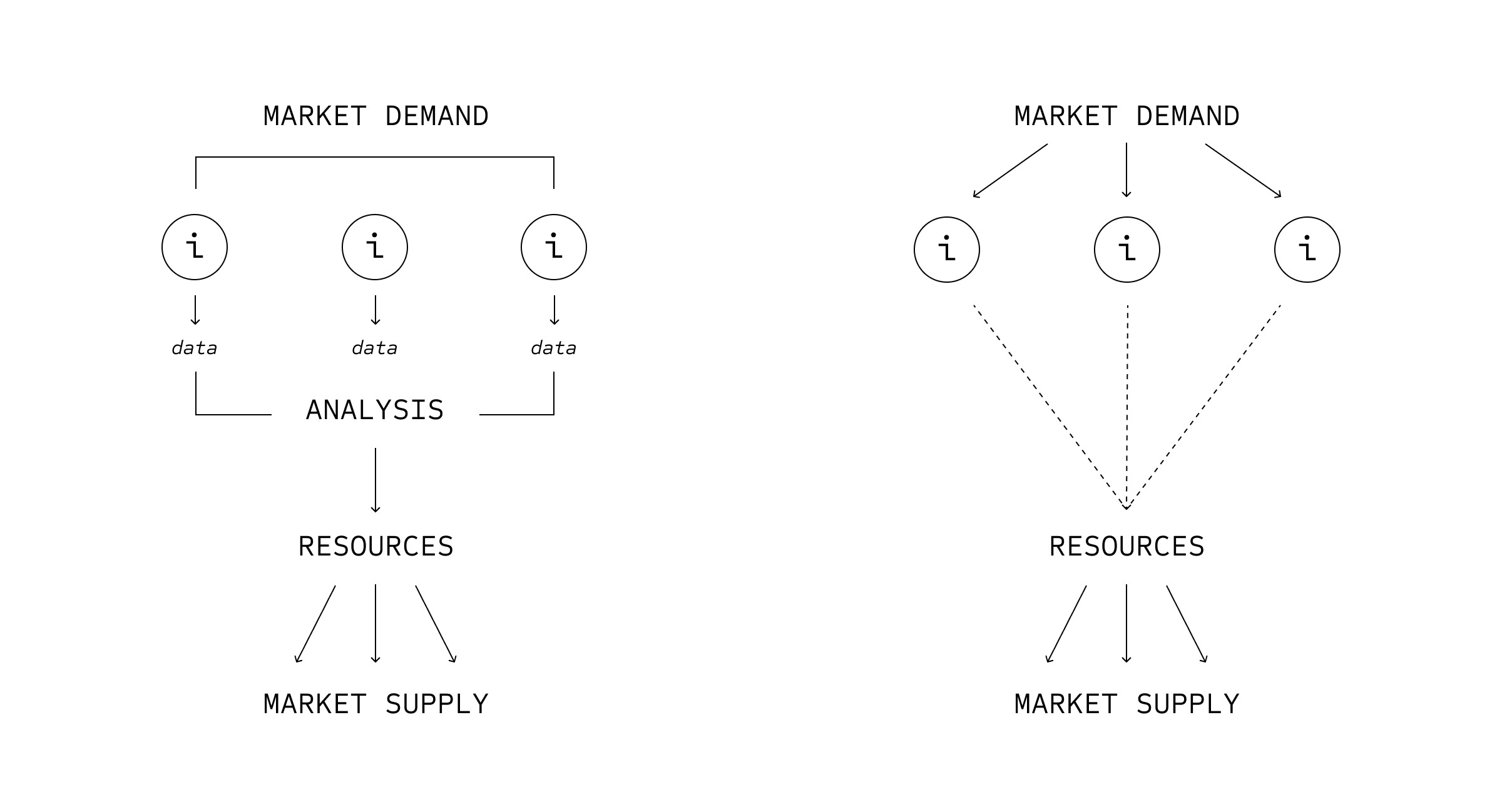
Urban planning and development systems worldwide are built around stocks: zoning allocations based on projected housing need, transport models fed by decennial census data, economic strategies keyed to employment statistics that arrive months after the conditions they describe. Data on stocks, gathered in periodic snapshots, describes what the city was, not what it is becoming. To measure continuous flows is to see the city clearly, sensing change as it happens and revealing emerging conditions before they cascade irreversibly.
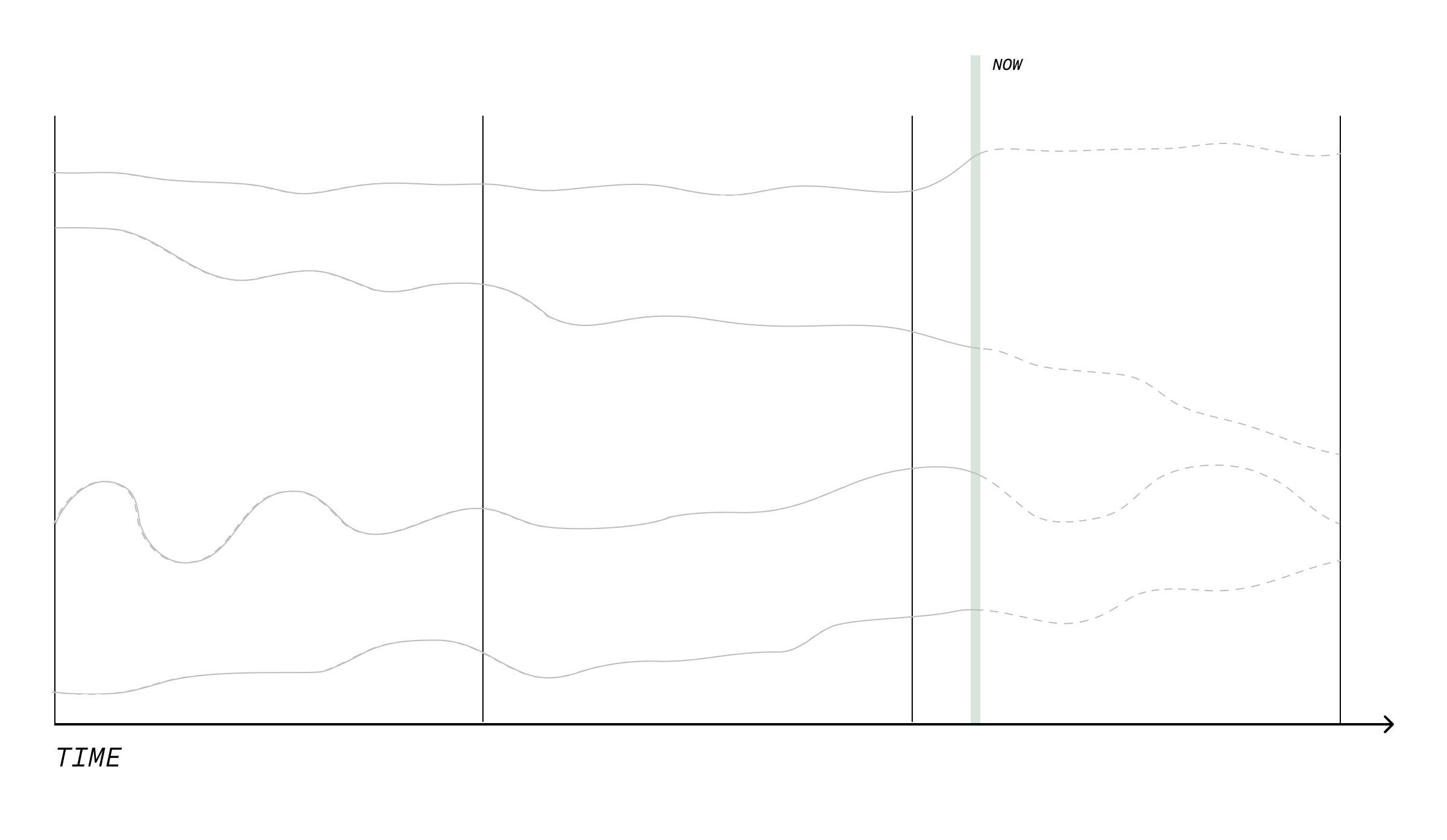
Cybersyn aimed to capture flows of information and use them for real-time management of the industrial ecosystem. In socialist Chile, control was centralized – but real-time information on flows would be no less valuable in a market context.
Local real estate is a good example. In the United States, more than 217 million square feet of office leases are scheduled to expire by 2028, the largest wave of tenant decisions in commercial real estate history. Yet the data describing this shift remains fragmented: municipalities hold property records, developers hold pipeline data, a handful of brokers hold transaction intelligence, platforms like CoStar and Loopnet have listings, and data does not flow freely between any of them. Vacancy figures are self-reported, methodologically inconsistent, and often months out of date. Transactions are (sometimes) recorded when deals close. There is no shared infrastructure for tracking occupied and unoccupied space in real time – and this is exactly the information that property owners need to make critical decisions about investing in building conversion or upgrades, selling, or exploring meanwhile uses.
The goal of a contemporary cybernetic information system should not be to eliminate real estate markets but to make them function adaptively. What might be possible with a comprehensive data infrastructure that treats real estate information as a shared civic resource? This kind of information would sharpen competition among private firms, shifting competitive advantage from relationship capital to analytical capability. It would enable experimentation with nimble supply-side models that meet emergent demand – models that would be rewarded with activity and revenue. Governments would gain the visibility they need to make proactive decisions about land use, incentives, and housing, rather than reacting to crises already underway. There are no meaningful technological barriers to this kind of data. The primary challenge is public-private collaboration and data stewardship.
The city that can see itself clearly – the city that has built recursive feedback between what its buildings are doing and what is needed of them – is one capable of generating real civic value. The legacy of Project Cybersyn may not be in replacing markets, but in laying a sociotechnical foundation for understanding what is possible when actors have the information they need to act well within a market.
“I said before that there are solutions, but I have also shown that they concern organizational modes. They concern engineering with the variety of dynamic systems. By continuing to treat our societary institutions as entities, by thinking of their organizations as static trees, by treating their failures as aberrations – in these clouded perceptions of the unfolding facts we rob ourselves of the only solutions.”
— Stafford Beer, “The Real Threat to ‘All We Hold Most Dear,’”
CBC Radio Broadcast, 1973