
Vertical Integration and Regional Economies
Detroit, Rochester, and the link between manufacturing networks and resilience.


Detroit and Rochester built their economies around brands the whole world knew—Ford and Kodak—and both paid a price when these names contracted. This week we look at what each city was left with, and why the outcomes diverged. The answer has less to do with how successful the flagship company was than with the web of firms, workers, and knowledge that surrounded it.
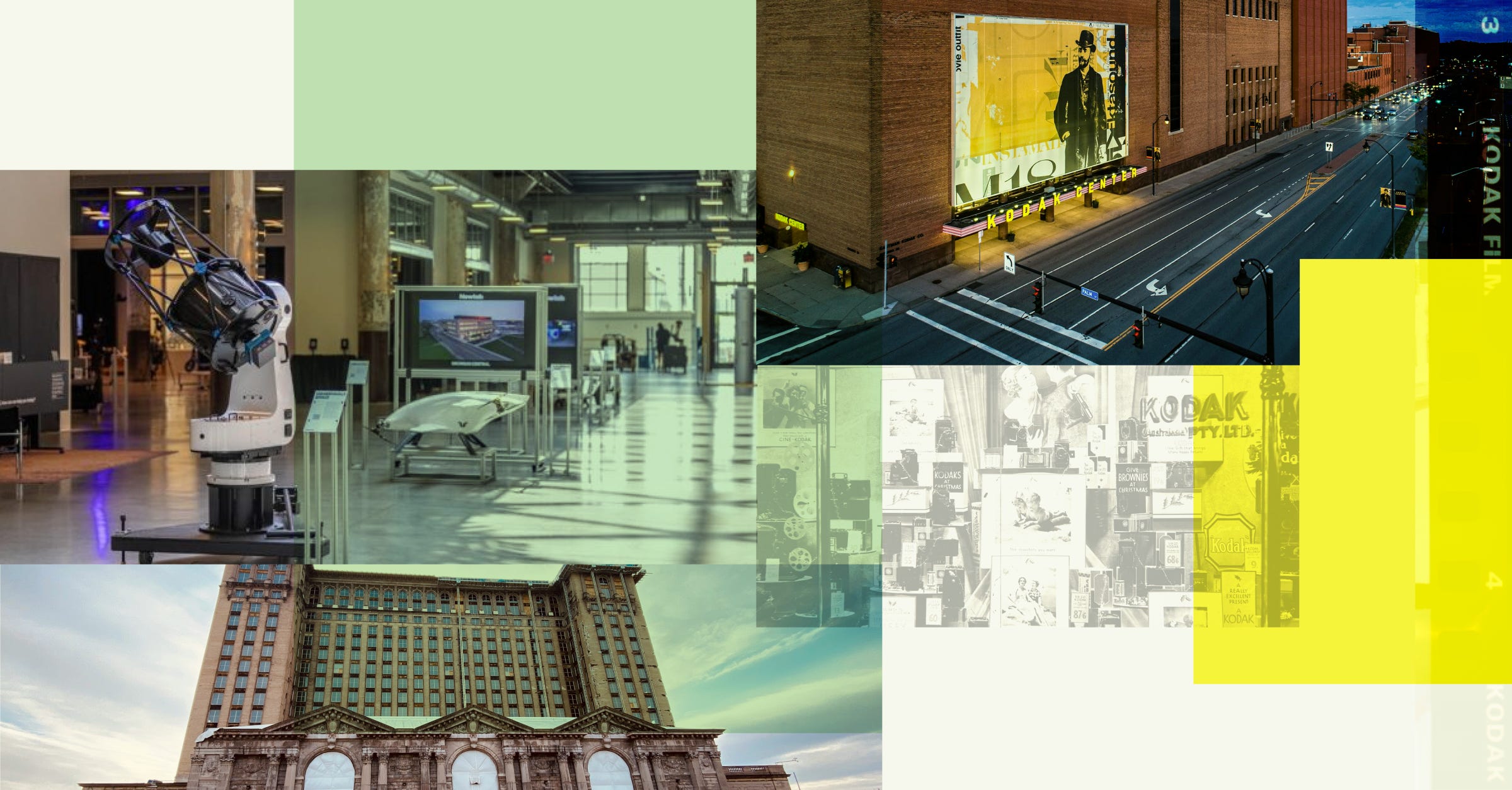
Does a city’s resilience have anything to do with its narrative? Last week we made the case that it does. Cities with a stronger sense of self—a clear story about who they are, grounded in what they make—have better tools for reinvention when they are hit by economic and social shocks. Those cities know what they’re building on and they have inherited resources. Rochester was a strong example, and this week we go deeper, bringing Detroit into the mix.
Cars and cameras don’t have much in common. But the cities that built them do. Both Detroit and Rochester were shaped by dominant, campus-bound companies with charismatic products that the whole world knew. Both cities concentrated their industrial identity on strong brands—Ford, GM, and Chrysler on one side; Kodak on the other. Both built sprawling, self-sufficient campuses that operated like cities within cities, with their own power plants, roads, and workforces in the tens of thousands. And both cities watched as their business titans contracted, leaving behind vast footprints and uncertain futures for the urban economies they once bolstered.
What follows is an overview of two centralized production models—and what happened when each confronted a set of disruptions: digital technology, offshoring, and the slow unwinding of twentieth-century manufacturing. Neither city escaped unscathed. But both found, in different ways, something worth building on. The outcomes, as we’ll see, were not the same. And the reasons expose something structural about how industrial identity is built, lost, and, in some cases, recovered. Identity is not the only determinant of resilience—the structure of the regional production economy is also a defining factor.
Detroit
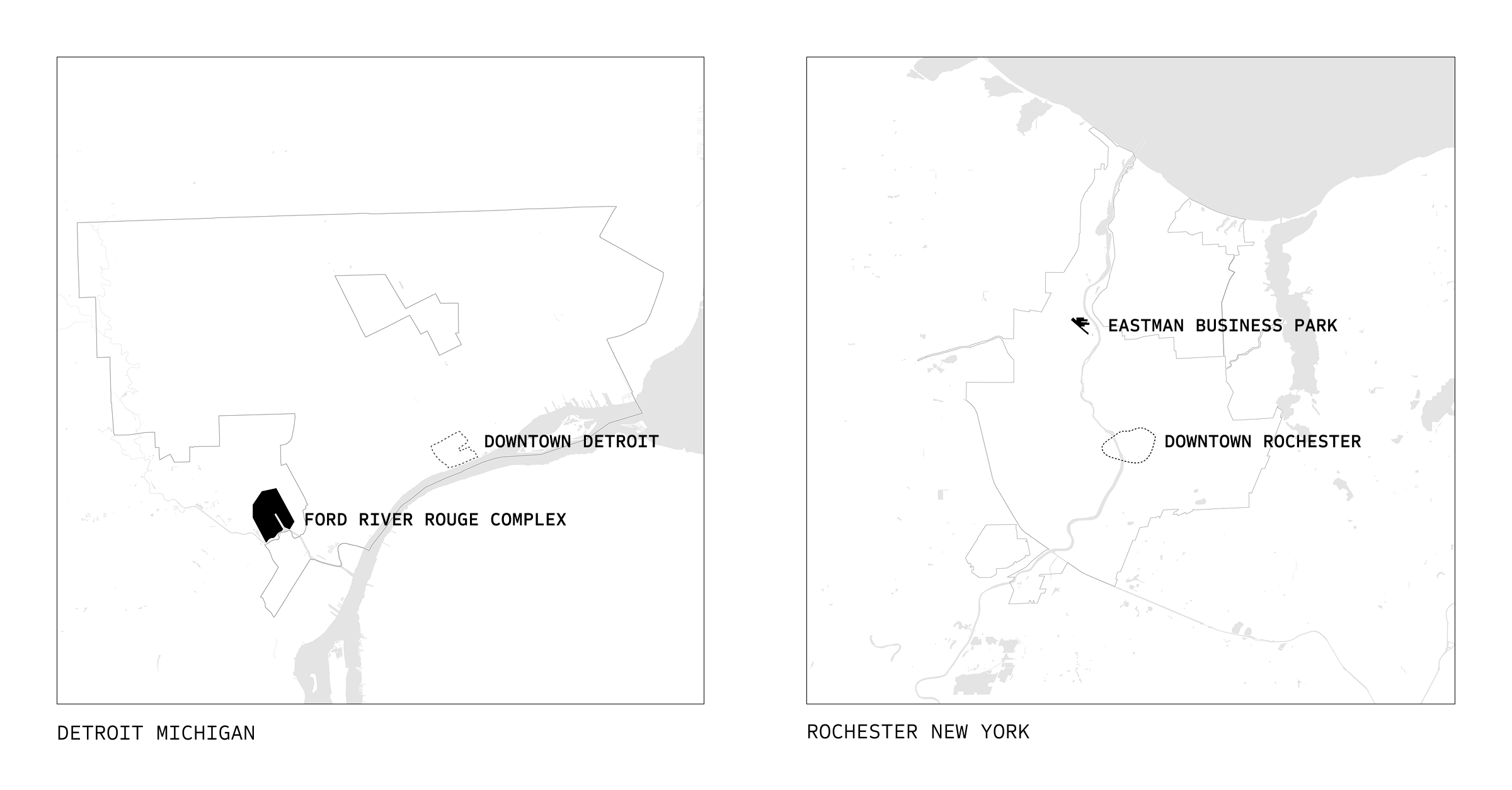
Henry Ford is known for the automobile, but his true innovation was the assembly line—an efficient method of making a complex product quickly and consistently. Ford’s River Rouge Complex, ninety-three buildings spread across 2,000 acres, was itself an assembly line. Iron ore and raw materials arrived at one end; finished automobiles departed from the other days later. Between those two points blast furnaces, coke ovens, a steel mill, a glass plant, a tire factory, a power station and assembly facilities worked in tandem. By 1940, over 100,000 workers clocked in each day. By 1950, Detroit was the fifth-largest city in the United States, and River Rouge set new benchmarks for the size and efficiency of an integrated industrial complex.
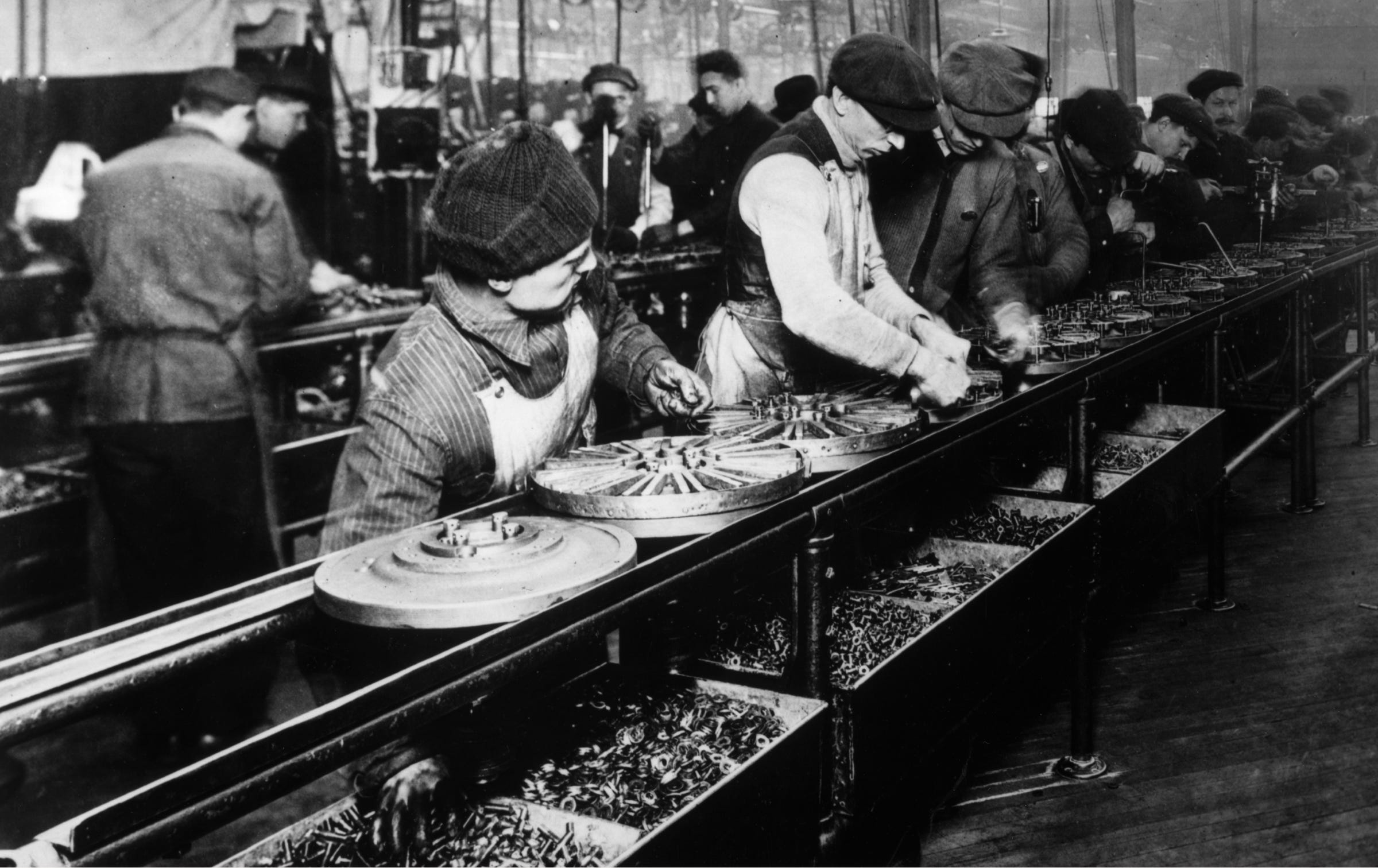
Diego Rivera spent three months sketching the interior in 1932, captivated by the molten metal, the human-machine choreography of the assembly line. Charlie Chaplin visited too, studying the Rouge for Modern Times. Both artists were enchanted by industry as a total system, self-sufficient and self-contained.
Chrysler and General Motors followed Ford’s lead, creating vertically integrated facilities of their own. Across each of the “Big Three” the goal was to vertically integrate, eliminating the need for local suppliers and creating advantages in terms of efficiency and control. Vertical integration created disadvantages, however, for the Detroit region.
A combination of pressures—foreign competition, rising labor costs, and a failure to anticipate fuel-efficiency demands—took their toll on The Big Three. When Ford, GM, and Chrysler contracted, there was no ecosystem of smaller firms to catch displaced workers and no network of specialized manufacturers that might pivot to new products. Detroit had large automobile companies, it did not have a regional industrial ecosystem for creating automobiles—a web of interdependent firms sharing knowledge, competing for talent, and spinning out new ventures.
The Detroit Three automakers went from controlling over 90% of the U.S. market share in the 1940’s, to only 17% of the U.S. total vehicle volume today, and in 2013 Detroit became famous for largest municipal bankruptcy filing in U.S. history.
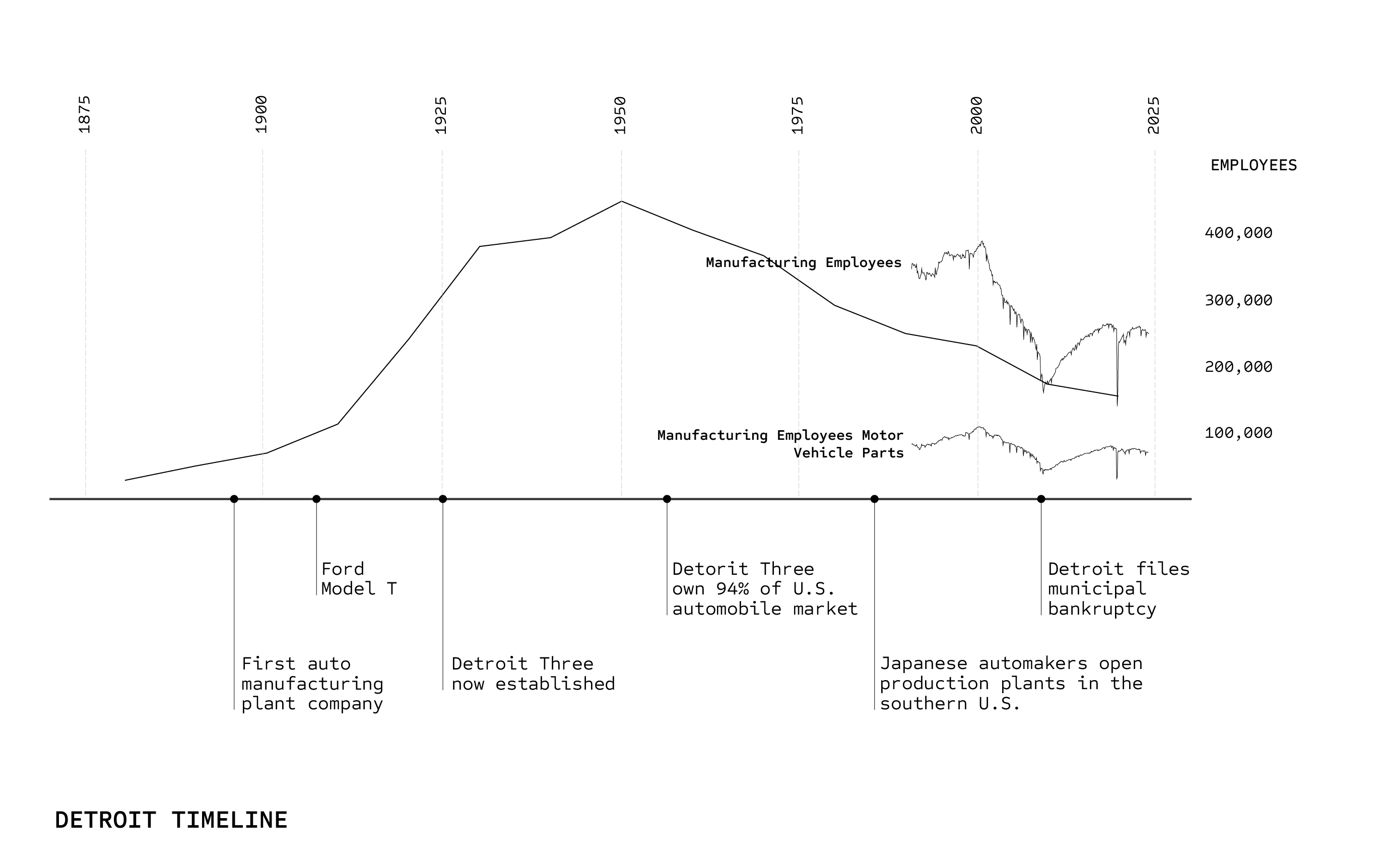
But the story doesn’t end in bankruptcy. The River Rouge facility still operates. Ford builds F-150 Lightnings there now, on 600 acres—less than a third of the original footprint. The blast furnaces, glass plant, and tire factory are gone. What remains is an assembly operation, its components arriving from suppliers scattered across the US and far-flung continents.
The sense of opportunity that followed Detroit’s bankruptcy drew a new kind of energy to the city. Land was cheap, and a generation of inventive projects emerged. Little Village is an emerging cultural corridor that encompasses a skate park, a sculpture garden dedicated to the late artist Charles McGee, a boutique bed-and breakfast, a bar and two restaurants, as well as office space for nonprofits. West riverfront park would almost certainly have become a private mixed use development if the City had not experienced a decline and re-emergence. Shinola brought watchmaking back to the United States with its Detroit workshop—and now includes an expansive manufacturing operation and a boutique hotel. After decades in the shadow of the Big Three, a regional ecosystem is flourishing.
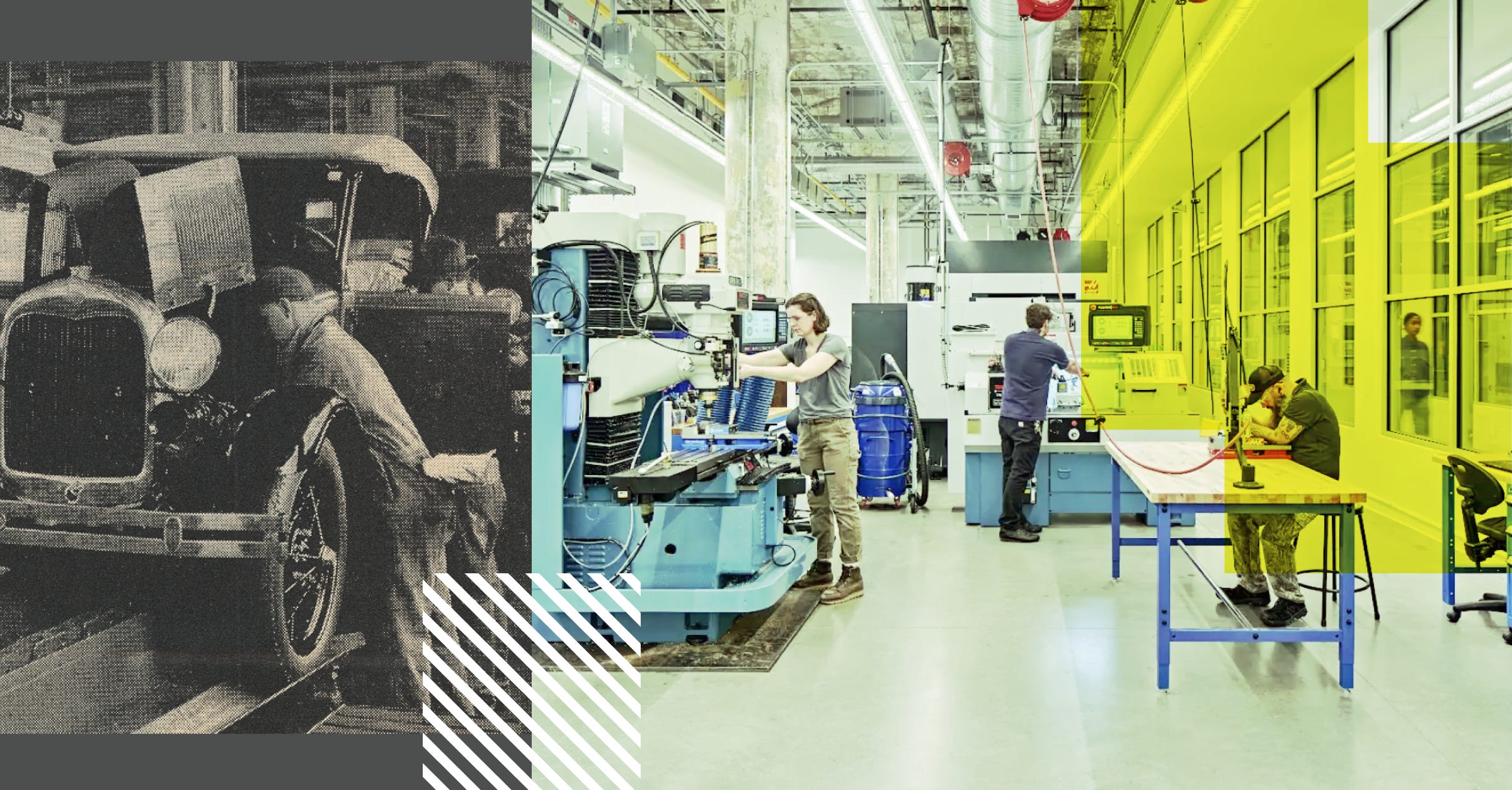
Michigan Central is a punctuation mark to this story. The 30-acre project is focused on mobility innovation, societal impact, and culture, and it is centered on the long-derelict Michigan Central Station, an icon of pre-automobile transportation. This is the most visible signal of Detroit’s attempt to rewrite its industrial identity—and Ford was heavily involved. Today, the campus hosts startups and research groups working on autonomous vehicles, micro mobility, and electric propulsion, through a partnership with NewLab. Field States contributed analysis and strategic design work for Michigan Central, envisioning a new workplace fit for a today’s innovation processes. Michigan Central is a billion dollar bet that Detroit’s manufacturing depth—its engineers, its supply chain knowledge, its production culture, and its self-narrative—is the right substrate for the next generation of mobility technology.
Rochester
Throughout the four decades from 1950 to 1990, a full wall of New York’s Grand Central Station displayed an advertisement for the American experience. Well, an ad for Kodak, but the camera company was an American icon. This was true in more ways than one—as much as Kodak represented travel, leisure, and family values, the company was a symbol of American manufacturing.

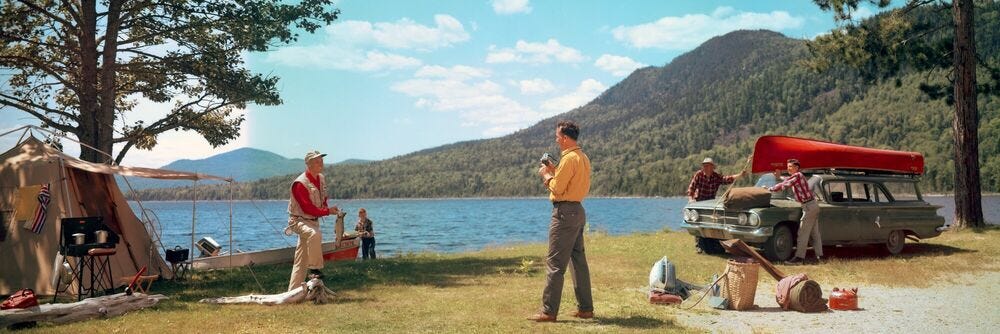
A short train ride away from Grand Central Station, Rochester was the global center of camera invention and production. At its peak, Kodak employed 62,000 people in Rochester, roughly half of the city’s working population. Kodak’s campus, the Eastman Business Park, had 154 buildings, including laboratory, manufacturing, and office space, as well as its own power plant, railroad, fire department, and thirty miles of internal roads.
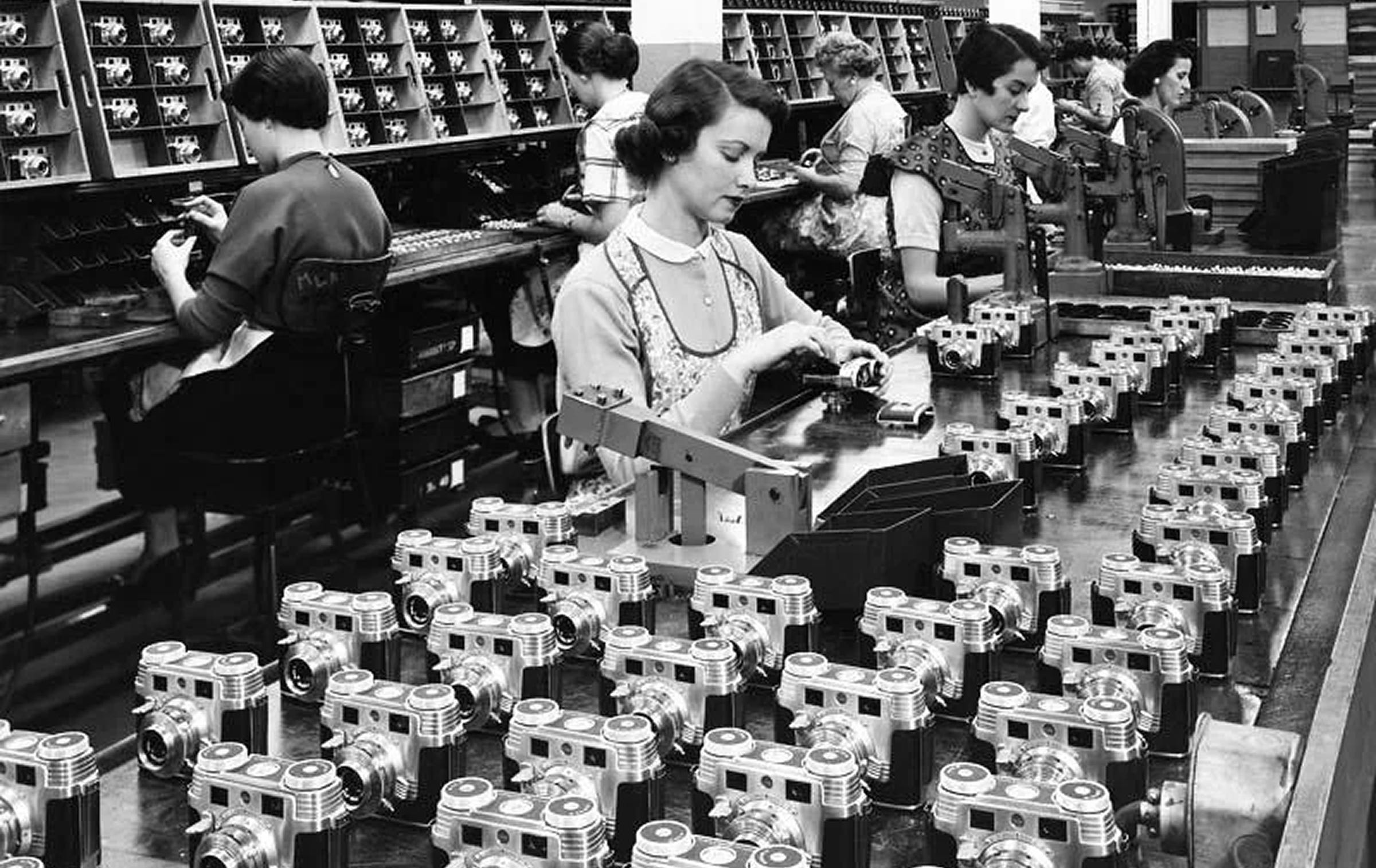
Unlike Ford, Kodak did not vertically integrate. An ecosystem of suppliers sprang up around it, including Bausch & Lomb, Wollensak Optical Company, and Graflex Inc. Together, these companies manufactured every component in a complete photographic supply chain, including film, optical lenses, camera shutters, photo paper and chemicals.
When digital photography emerged, Kodak moved slowly and the business model collapsed. A long decline ended in Kodak’s bankruptcy filing in 2012. Fifty buildings have been demolished since; controlled explosions drew crowds of former workers to watch an icon reduced to rubble.
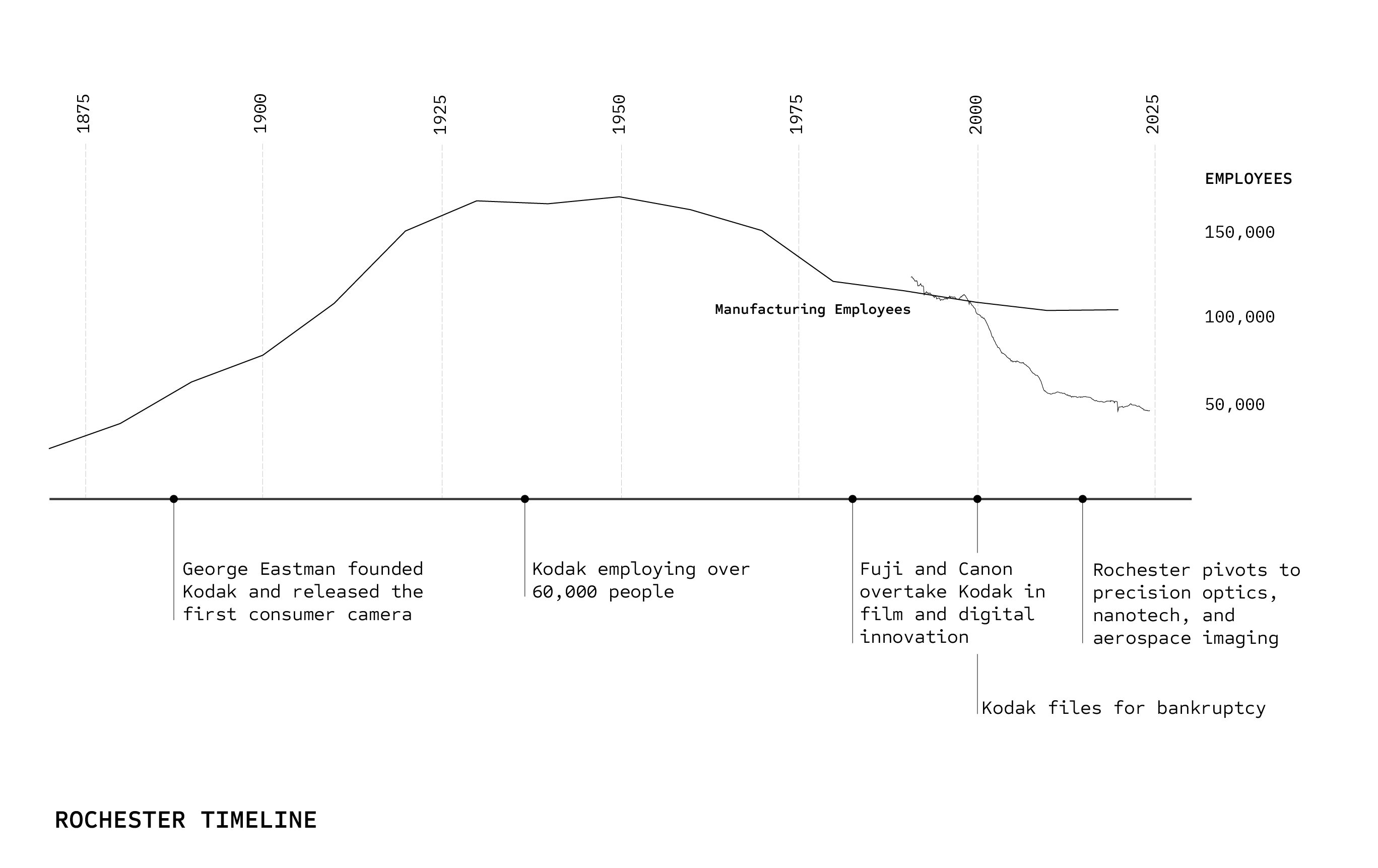
But the campus is alive with something Kodak never anticipated. A cross-sectoral ecosystem for optics innovation—including the American Center for Optics Manufacturing, Optimax Systems Inc, and AIM Photonics—has grown from the knowledge Kodak spent decades accumulating. Rochester has contributed to the Hubble Space Telescope, scientific advances in the coherence theory, high-precision military applications, advanced lithography for semiconductor manufacturing, and now quantum computing. The campus has also become a home for entirely new industries—companies as diverse as cannabis and advanced textile production have adapted vacant industrial space.
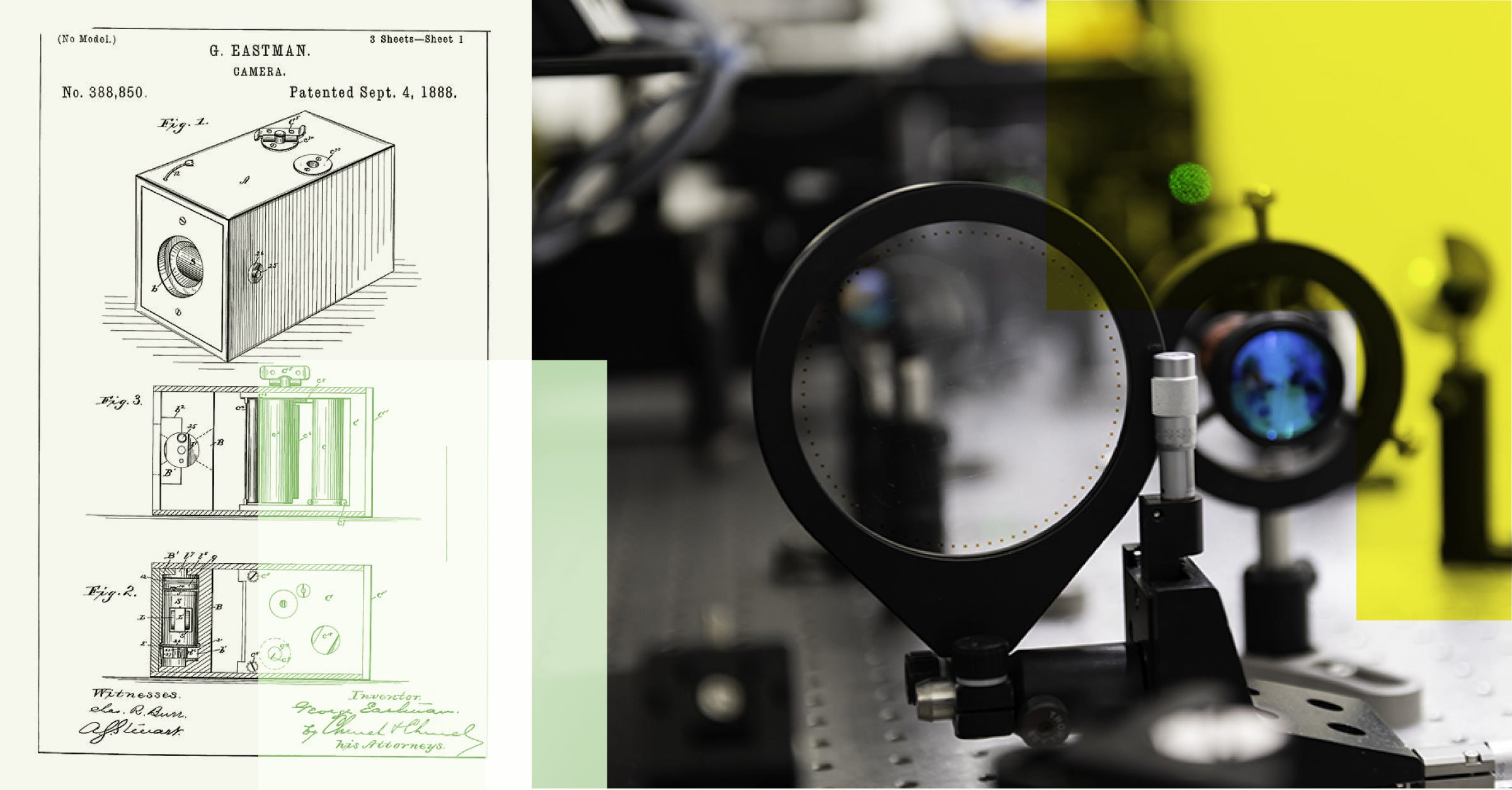
Six thousand people work at the Eastman Business Park today, a fraction of Kodak’s peak workforce, but a telling representation of contemporary business models and production methods; it is currently home to 114 companies and is leasing over 200 acres.
Before George Eastman died in 1932, he asked that his ashes be interred at Kodak Park. He loved this place, and his work had an extraordinary influence on what Rochester became. Eastman’s legacy is alive in the campus that is thriving once again; a multitude of innovative companies in place of the American monolith that Eastman built. Even outside of the campus, Rochester’s economy is laced with the history of Kodak.
Resilience depends on narrative and manufacturing networks
Rivera’s murals captured a moment when industrial control was strength. The decades since have demonstrated otherwise, and as behemoth firms stumbled, the cities they bolstered rapidly declined. When production concentrates in a single organization—vertically integrated, campus-bound, self-sufficient—the organization’s decline leaves little behind. Those that weathered deindustrialization best had diversified manufacturing bases—dense networks of small and medium firms that could adapt when any single company failed. When a city’s production capacity is distributed across an ecosystem of firms sharing knowledge, competing for talent, and spinning off new ventures, disruption has a softer impact on the system. Rochester proved this too, imperfectly and at real cost, but durably.
Detroit and Rochester offer the same structural lesson from different angles. Where production concentrates without an ecosystem, narrative can sustain potential but cannot substitute for network. Detroit is rebuilding, thanks to the ecosystem that emerged post-bankruptcy. Where narrative and network reinforce each other, the city is more resilient. That distinction—between a story a city tells about itself and the actual web of firms and people that carry industrial knowledge and narrative forward—is what determines the rate and character of revival.
The next Production Potential post turns to Grand Rapids, Providence, and Portland—cities that didn’t concentrate production in a single campus or brand.